

I don’t remember the first time I heard or read about a GTM engineer. It was probably over coffee near Parque Centenario a few months back: a former coworker told me she was prepping to apply for roles like that. My first thought was: “come on, now everybody gets to be an engineer?”
Then, more recently (September 9, 2026, to be exact), Clay announced a Series D of USD 115 million at a USD 7.1 billion valuation. In the same announcement, it revealed it’s putting USD 1 million toward scholarships to train GTM engineers. In other words: the company that sells the tool is also funding the training for the people who’ll use it. Geniuses!
With that on the table, the suspicion seems fair. We wanted to figure out whether GTM engineering is a new discipline, a rebrand with good PR, or a bit of both. We came out confused, but we laughed a lot, and hey, the important thing is the LinkedIn friends we made along the way!
What GTM engineering is
GTM engineering (go-to-market engineering) is the practice of building and automating the systems a B2B company uses to win customers: enriching prospect data, catching buying signals, scoring leads, and triggering outreach without anyone doing it by hand.
Whoever does that work is a GTM engineer, sometimes written “go to market engineer.” Clay coined the title, describing these people as folks who build revenue systems and think about growth systematically. According to the company itself, people land in the role from RevOps, growth marketing, software engineering, and even design.
Aaron already explained what a GTM engineer does and when it makes sense to hire one, with a table comparing the role to RevOps, sales engineering, and SDR. Here we’re sticking with the other question: how much of this is substance, and how much is marketing?
What Clay is, and why it benefits from the role existing
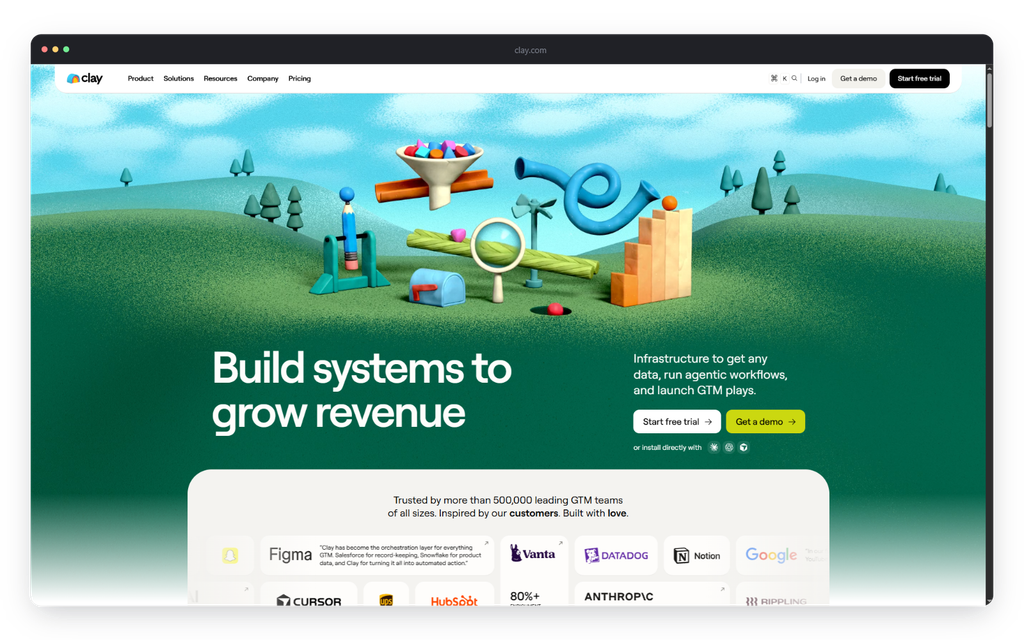
Clay is a data and automation platform for sales teams: it enriches prospect data with AI and builds outreach workflows, which is why a lot of people search for it as “Clay AI.” It claims more than 17,000 customers.
The move has precedent: HubSpot invented inbound marketing to sell a CRM, and it worked so well that it’s now a discipline with its own playbooks (we’ve already written about how HubSpot is doing with its own SEO). Clay did something similar with a job title. It named its ideal user, then went out to train them.
Job listings show just how tied the role is to the tool. A survey by Onfire of 209 job postings found Clay mentioned in 66% of them, ahead of HubSpot (50%) and Salesforce (48%).
On one hand, I have to tip my hat to what Clay pulled off: creating a job title tailor-made for you is a masterstroke. On the other hand, it bothers me to think about who gets to ride this wave and who doesn’t, given we’re talking about jobs in a market that’s already volatile and tough for those of us working in it.
GTM engineering vs. RevOps: the arguments
RevOps (revenue operations) is the function that organizes processes, data, and tools across marketing, sales, and customer success so revenue becomes predictable. This is a position that’s been around for years.
Henley Wing Chiu, of Bloomberry, analyzed GTM engineer job postings published over a year and found that 9 out of 10 responsibilities also show up in RevOps engineer postings. Liz Christo, of Stage 2 Capital, put it more bluntly: for her, a GTM engineer is, in practice, RevOps.
The second argument is about proportion. Kyle Poyar counted job postings between June and August 2025 and found one GTM engineer listing for every 14 RevOps listings and every 92 SDR listings. He also cited an estimate that 45% of people holding the title work at agencies or as consultants. That data point is over a year old and the market has grown since, but it’s useful for context. A lot of the noise comes from people selling the service.
The third argument matters most to us. Automating outreach doesn’t improve the message. If nobody cares about the pitch, a thousand AI-personalized emails are just a thousand emails that go unanswered.
What isn’t hot air
Demand has genuinely grown. According to Onfire, GTM engineer job searches rose 205% year over year. And the pay is good. Per Bloomberry’s analysis, the median salary in postings that disclose pay is USD 127,500 a year, with an average of 4.11 years of experience required.
The profile is also more technical than a classic RevOps role. SQL and Python each show up in 38% of postings, per Bloomberry. Onfire found that 95% mention AI, language models, or agents, and that each posting names an average of 6.4 tools. Somebody has to make all of that work together.
That said, the role is still small. As of May 2026, there were roughly 1,200 people with the title on LinkedIn, and 91% of companies with a GTM engineer have exactly one (data from Extruct, cited by Onfire). A function being new and overhyped doesn’t make it fake. We’ve seen this movie before in tech, and we’ve got another piece on how to build a company that survives the hype.
So, is GTM engineering hot air or not?
The role is real. The discourse around it is inflated, especially when it comes from whoever’s selling the tool or the service.
A GTM engineer scales what’s already working. If you have a message that converts, a well-defined ideal customer, and a sales team that can handle whatever comes in, automating multiplies your results. If you’re missing any of those three things, it multiplies the problem instead.
That’s why order matters. Narrative comes first: what you’re selling, to whom, and why they should believe you. Pipelines come after. It’s the same logic we applied to content when we wrote about what you shouldn’t automate, and it ties into what we’ve been saying about distribution.
Before you open a search or hire a GTM engineering agency, ask yourself three questions:
- Does the message already work manually? If ten emails written by a person don’t land a meeting, ten thousand automated ones won’t either.
- Who’s recommending this to you? Check whether they’re selling the tool, the course, or the service.
- What are you going to measure? Qualified meetings and pipeline. Send volume alone tells you nothing.
With that said, we’ll leave it here. If you ask me, the market simply changed and is now demanding a capability update from a job that already existed. That rebrand is what really happened on the way from RevOps to GTM engineer. In an era where we’re all becoming engineers, because we talk with AI and our work has become macro, system-observation work — whether in marketing, tech, or crypto — rather than artistic-creation work, say, manually operating content or code.
In short, in a world that’s training us to edit and approve insights generated by a robot, it makes sense that we’ve stopped thinking of revenue operations as such and started thinking of them as an engineering discipline for reaching the market. I don’t want to get all Lacanian about it, but I think that says it all.
Shall we leave it there? See you next week.

By Circe Galanternik
Frequently asked questions
What is GTM engineering?
It’s the practice of building and automating a B2B company’s commercial systems: prospect data, buying signals, scoring, and outreach. The term was popularized by Clay, the company that sells the tool most requested in job postings for the role.
How is GTM engineering different from RevOps?
RevOps organizes and maintains revenue processes, data, and tools. A GTM engineer builds new automations, with more code and AI involved. In job postings, 9 out of 10 responsibilities overlap (Bloomberry, 2025).
What is Clay?
A data and automation platform for sales teams. In September 2026, it raised USD 115 million at a USD 7.1 billion valuation and claims more than 17,000 customers.
Is GTM engineering just a fad?
The demand and the salaries are real, but the role is still small, and a lot of the noise comes from agencies and vendors. It’s useful for scaling a sales strategy that’s already working.