

A while back, someone showed up on my battered X (formerly Twitter) timeline observing that marketing jobs were being rebranded as technical jobs. Now, someone who does content marketing reduces their job to managing automated content production pipelines, and consequently presents themselves as a “content engineer.” According to this commentator, the rebranding was meant to masculinize marketing roles so they’d seem more respectable. I’m not particularly interested in that gendered reading, but I am interested in the idea that we’re at a moment where “non-technical” roles need defending, and as part of that defense, it’s become urgent to disguise them as technical roles.
Perhaps the most popular of these neo-engineers today is the “GTM engineer.”
This article aims to answer three questions:
- What is a GTM engineer?
- Why is there so much interest in this role at this particular moment in the tech industry?
- Should you hire a GTM engineer?
Without further ado –
What is a GTM engineer?
A GTM engineer designs and maintains sales systems that operate at scale. Clay, the company that coined the title and sells the tool most associated with the role, holds that the GTM engineer’s core function is to build new systems and run experiments.
This, at least in prescriptive terms, sets it apart from similar roles:
| Dimension | Revenue Operations (RevOps) | Go-To-Market (GTM) Engineering | Sales Engineering (SE) | Sales Development Representative (SDR) |
|---|---|---|---|---|
| Mission | Govern and optimize: Ensure the marketing & sales lifecycle runs with reliable forecasts and clean data | Build and automate: Develop infrastructure so pipeline generation can scale. | Translate and validate: Act as the prospect’s technical consultant. | Execute and prospect: Run outreach to capture potential customers. |
| Technical depth | Medium | High | High | Low |
| Customer relationship | Limited – Operates internally. | Limited – Operates internally. | Direct – toward the middle/end of the sales cycle, aimed at overcoming objections. | Direct – at the start of the sales cycle, as the first point of contact. |
| Most common KPIs | Funnel velocity, data accuracy, net revenue retention (NRR), and forecasting accuracy. | Automated pipeline volume, system uptime, cost per enriched lead. | Technical win rate, proof-of-concept conversion rate, sales cycle acceleration. | Number of qualified meetings booked, sales-qualified leads (SQLs) generated. |
| Most common compensation type | Salary + bonuses | High base salary, no commissions | High base salary plus commission on closed deals (70/30 – 80/20) | Base plus performance-tied commission |
Why would you want to hire a GTM engineer?
In tech, it’s very hard to find reliable data on almost anything, since most organizations commissioning research have a commercial stake in the results. This is one of the challenges Postdigitalist aims to address. That said, the clearest figure we found on growing demand for GTM engineers comes from GTMEPulse. According to the site, demand for GTM engineers grew 5,205% over the past year, with more than 3,300 active job listings today.
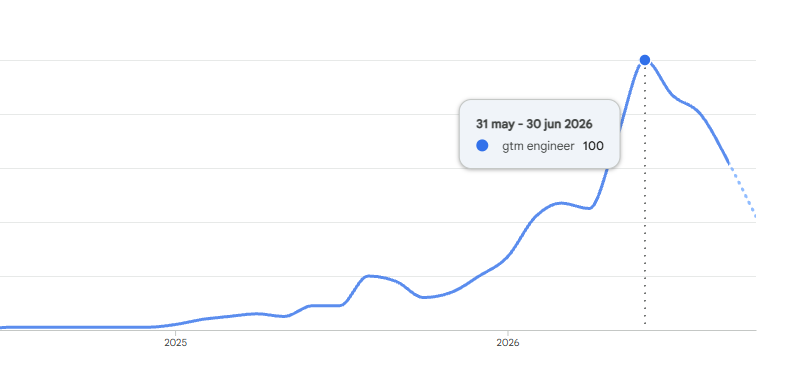
Google Trends, in turn, shows a 5,000% increase in interest in the term “GTM engineer” since 2025, peaking this past June.
What’s going on?
As I mentioned a few paragraphs back, the term “GTM engineer” was coined by Clay. In other words, the company that built the software of choice for GTM engineers also won the legibility arbitrage and slapped a label on its ideal buyer. To sell a CRM, Hubspot invented a subdiscipline within marketing: inbound marketing. To sell a prospecting automation platform, Clay invented a job title: the job is, basically, “Clay user.”
But why now? What came before Clay and GTM engineers, narratively speaking? Personalization at scale and the complex workflows made possible by generative AI.
The story went roughly like this:
- Generative AI made granular outreach possible at scale.
- There was a Sales Tech boom.
- Clay defined the “GTM engineer” job title.
The GTM engineer acquires and operates various Sales Tech platforms to orchestrate granular outreach flows at scale.
We can read the new interest in hiring GTM engineers as an attempt to capture some of the efficiency that AI brings to sales processes. According to Gong, teams using AI in their sales process generate 77% more revenue per rep than teams that don’t.
Even so, despite the enthusiasm GTM engineering and Sales Tech are generating, according to Gong only 46% of salespeople are hitting quota. This phenomenon is likely multicausal, but one of the biggest factors dragging down productivity is the sheer amount of busywork involved in managing and orchestrating software. Stacking tools on top of a fragile system produces disasters. Could a GTM engineer save you from that? Yes.
Should you hire a GTM engineer?
With all that said, should you hire a GTM engineer?
GTM engineers build systems to sell at scale and run experiments.
It’s not a GTM engineer’s job to:
- Position your brand.
- Define the brand’s competitive advantages.
- Define the brand’s ideal customer profile.
- Design a sales operation from scratch.
If anything, that’s the role of The Program.
A GTM engineer operates on certainties. It’s not the GTM engineer’s job to validate the commercial strategy, but to develop and validate methods to scale it.
You’ll want to hire a GTM engineer if:
- You have a well-established sales team
- You have product-market fit
- You want to increase your brand’s penetration in a well-defined market
That said, it may not be the right time to hire a GTM engineer – or your company may not need one at all.
Let’s look at some signs that you shouldn’t hire a GTM engineer, and which profile to look for instead:
| Signal | Solution |
|---|---|
| No sales team able to absorb and develop the leads captured by GTM systems. | Audit processes. Expand the sales team by hiring SDRs. |
| Small total addressable market that needs to be worked IRL/1-to-1 from first contact. | Hire account executives, plan for long sales cycles that require a “quality over quantity” approach |
| Improvised sales processes with limited traceability. | Hire a Revenue Operations specialist to manage them |
| Plans to expand into a new market. | Only add a GTM engineer once the company has successfully penetrated the new market. |
In short: A GTM engineer aims to scale what already works. If that’s what your company needs, go for it. If what’s supposed to work still doesn’t, look for a specialist who can help you revisit your positioning.

By Aaron Marco Arias
Frequently asked questions
What is a GTM engineer, and how does it differ from RevOps, growth marketer, or SDR?
A GTM engineer designs, builds and maintains the systems that let pipeline generation scale: data enrichment, scoring, automation and outreach. RevOps governs and optimizes the lifecycle (forecasting, clean data). The SDR runs outreach by hand. The growth marketer works on channels and campaigns, not infrastructure. The practical difference is that the GTM engineer builds the machine, rather than running the campaigns.
Do I need a GTM engineer, or is it just a fad?
There’s a bit of both. Interest spiked partly because of a categorization move: one of the leading companies in Sales Tech named its ideal buyer. But the problem the role addresses is real: generative AI made personalized outreach at scale possible, and someone has to orchestrate it. If you already have a sales team and product-market fit, you probably need one. If not, wait.
Does a good GTM engineer have a technical profile, or more of a sales one?
There are GTM engineers with a technical background, and others with a sales background. Your needs will determine which profile is ideal for you. If the problem is infrastructure (dirty data, disconnected tools), go technical. If the problem is message quality and segmentation, go sales. The ideal profile is a hybrid, but in practice you have to decide which weakness is more costly. At a minimum, a GTM engineer should understand how a sales operation works, because a technically flawless system that generates irrelevant leads is useless.
When does it make sense to hire a GTM engineer?
It makes sense to hire a GTM engineer once you already have an established sales team, product-market fit and a well-defined market. A GTM engineer operates on certainties: the job is to scale what works, not to discover it. If you’re entering a new market, wait until you’ve successfully broken into it before adding one.
How do I evaluate someone in a field as new as GTM engineering?
There are no standard credentials, so evaluate based on concrete work: ask for an applied test (designing an enrichment and outreach flow for your ICP), have them explain their decisions, and ask them to show systems they’ve built and how they measured them. Ask when not to automate. A good candidate can tell you what shouldn’t be scaled.
What results can I expect from a GTM engineer, and in how much time?
Reasonable results include automated pipeline volume, lower cost per enriched lead, and less busywork for the team. On timing, I don’t have reliable data: in this field, almost all of it comes from whoever is selling the tools or services. The sensible move is to ask for a limited pilot with a metric agreed on upfront, and to be wary of promises of results in a matter of weeks.
How do I attribute the impact of GTM engineering?
It’s hard, because go-to-market systems and the sales team both contribute to the same outcome. The cleanest approach is to measure what the role controls (automated pipeline volume, system uptime, cost per enriched lead) and split cohorts: leads originated by the system versus the rest, tracked through to close. Mixing its KPIs with sales’ makes it impossible to evaluate.
What does hiring a GTM engineer actually cost?
You need to add up four components: compensation (a high base salary, usually without commission), tool licenses, data and enrichment, and sending infrastructure (domains, mailboxes). On top of that comes the implementation time before the system starts paying off. I won’t give market figures, since they change quickly and vary a lot by region. It’s best to get current quotes.
Who should they report to?
Sales or RevOps if the focus is pipeline, and a C-level exec (CRO or CEO) if the role touches multiple teams. Avoid putting them directly under marketing: they’ll likely end up positioned as a campaign executor and lose the mandate to build infrastructure. Reporting lines shape incentives, so they should report to whoever benefits from the pipeline.
Full-time, freelance, or agency/studio?
Full-time if the volume of work and experimentation is constant. Freelance or a studio if you need to set up the system and then maintain it with less ongoing load. In that case, require documentation and make sure the workflows live in your company’s accounts. If your positioning still isn’t clear, the step before any of these three isn’t hiring at all – it’s working out the strategy.