
The pitch deck is the tool par excellence for startups seeking funding. I’d venture that, in 80% of cases, The Program consists of 4 weeks of agonizing over the pitch deck.
But what makes a good pitch deck?
Honestly, it depends. And while several funds will offer you a rough standard for how a deck should flow, this isn’t an exact science.
Aiming to be radically concise, we could say that pitch decks that work do one thing very well:
The thing they call “storytelling”
A pitch deck is a well-told story. Nothing more. It’s possible to have a great product but not quite know how to turn it into a good story. It’s also possible to have a non-product and turn it into an extraordinary story – the pitch deck for Theranos’s Series C is excellent.
The deck should flow like a story. This matters because:
- A well-told story holds investors’ attention better than an infodump.
- Whoever tells a good story takes control of the narrative and the conversation.
- A readable, well-structured story can generate emotional resonance. And the decision to invest in something is – at least partly – an emotional decision.
What should this story be about? A unique, high-potential-impact opportunity; and a team that is extraordinarily well positioned to seize it.

- Something is happening, there’s a macro trend, an emerging market, a stagnation in “the old way of doing things” that’s building up a pressure cooker of consumer frustrations.
- There’s a team with the clarity and experience to win the battle for the future of the sector (yours) – they understand what’s happening, they understand how to turn the solution into a working business, they get it.
- It’s later than you think. The investor should feel at risk of arriving just a little later than ideal. Part of the appeal of startups lies in their devotion to speed. There’s a very short window in which whoever invests and builds wins.
A pitch deck that works carries a whiff of what TV Tropes calls “Race for your love”, the cliché scene where the protagonist makes a bumpy journey to an airport or train station to stop the love of their life from disappearing forever. Of course, investors cast themselves in that starring role. This is a good moment to slip in a small truth, and then we’ll go back to examining these systems. It’s much easier to talk about human matters as if they only concerned things. Things are simple, engineering is a delight, social engineering feels like a post-apocalyptic discipline. I’ve already put too much emphasis on something I just want to whisper to you in passing: Few things are personal, people aren’t against you, they’re for themselves. A pitch deck has to feel like a story the investor wants to be part of. You’re pitching a success story in progress, not a problem, not a product.
Pitch deck examples: anatomy of the story
Articles like this one usually dig up antediluvian examples: AirBnB’s first deck, some round LinkedIn raised back when interest rates were abnormally low. We know the world in which those companies attracted investors is very different from the one a founder has to face today. So we’ve made a point of compiling fresh examples. You can see them in this Are.na board. The startups covered are Kalshi, Daytona, ElevenLabs and Perplexity – and we’ve also thrown in Theranos’s Series C deck, for good measure.
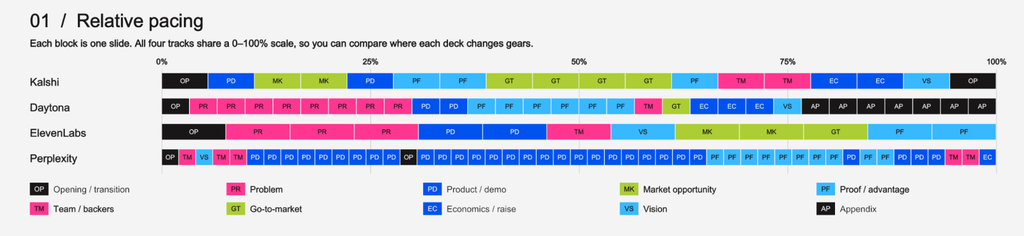
Studying the general structure of these decks, we find 10 “building blocks” available when putting one together:
- Opening/transition – necessary, obvious.
- Problem – presentation and explanation of the problem.
- Team/backers – social proof, risk minimizer (we all went to Stanford), and FOMO maximizer (your archenemies already invested).
- Go-to-market – explanation of the go-to-market/growth/market-penetration strategy.
- Product demo – can be a series of slides meant to be narrated, or an embedded video.
- Economics/raise – the company’s financial stage, the round’s ask, use of funds, and so on. Depending on the startup’s stage, this section can be very light or very complex.
- Market opportunity – What are we going after? What’s the TAM? What macro trend does this company embody?
- Vision – What read on the world justifies your winning this market?
- Proof/advantage – Do you have traction? What unfair competitive advantage do you hold?
- Appendix – A zoom-in on unit economics, roadmap details, and other resources that help answer specific questions.
Kalshi’s pitch deck
You’ve probably already heard of Kalshi – if nothing else, from its campaign infiltrating every cultural or sporting event out there. But before becoming an ominous presence in everyone’s feeds, Kalshi was an unknown startup pitching Sequoia Capital.
In its deck, Kalshi presents a market where you can trade contracts that pay out based on the outcome of an event. To explain it, the deck asks whether a COVID vaccine will be discovered by a certain date. The slide shows the two positions a trader can take. From there, the deck moves from one easy-to-picture contract to the infrastructure that would make it possible to trade thousands of different contracts.
Market opportunity
Kalshi places event contracts in a sequence that starts with grain futures, moves through other commodities, and arrives at interest rate swaps. The figures for those categories are notional volume references. They give scale to the historical analogy, while Kalshi’s own projections only appear at the end. Between the two, the deck explains how it would try to build liquidity, first with retail traders and liquidity providers, then with institutions, and finally with those looking to hedge against an event.
Team and product
The most concrete evidence about the team shows up before their bios. Kalshi displays its work with the CFTC, its clearing agreement with LedgerX, and four capabilities it claims to have built, including the exchange and the trade surveillance system. Only afterward does it introduce the executives and the team’s structure. By then, the reader already knows what those people had to solve to get the market off the ground.
Urgency
The regulatory timeline sets the moment for the pitch. The deck shows nearly two years of work and flags the designation as expected for November 2020. The second source of urgency is liquidity. If Kalshi manages to concentrate enough buyers and sellers, trading there becomes more attractive to the next wave of participants. The early-entry thesis hinges on that effect actually materializing.
Structure of Kalshi’s pitch deck
| Slide | What it shows and what it does in the pitch |
|---|---|
| 1 | Sums up the pitch as the possibility of trading on an event’s outcome. |
| 2 | Shows a contract on a possible vaccine to explain how the product works. |
| 3 | Places event contracts within the historical evolution of derivatives. |
| 4 | Uses the volume of earlier markets to give scale to the analogy. |
| 5 | Lays out contract categories, from economics and weather to science and culture. |
| 6 | Reconstructs the regulatory work and places the expected designation on the calendar. |
| 7 | Presents licensing, clearing, and liquidity as barriers to entry. |
| 8 | Identifies who provides liquidity and how it connects to the exchange. |
| 9 | Sequences the entry of retail traders, institutions, and participants seeking hedges. |
| 10 | Details the channels for capturing demand, from press to partnerships. |
| 11 | Links the creation of contracts on topical events to trader acquisition and retention. |
| 12 | Lists four capabilities already built, including the exchange and the platform for direct trading. |
| 13 | Introduces the executive team and the roles in leadership and advisory. |
| 14 | Shows how the 20-person team is organized. |
| 15 | Projects surpassing $5 billion in monthly volume within five years. |
| 16 | Projects annualized revenue above $350 million and explains the role of fees and data sales. |
| 17 | Closes with the vision of these contracts becoming part of the US financial system. |
| 18 | Opens the floor to questions. |
Pitch deck for AI startup Daytona
Within this article, Daytona keeps strange company. It’s a much lower-profile startup than Kalshi or Perplexity. But I decided to include its deck simply because it’s excellent.
Daytona’s seed deck presents infrastructure for development environments. The promise organizing the presentation is that a developer can open a project and start coding right away. To show how far reality sits from that ideal, Daytona walks the reader through installation, dependencies, and the waiting around. Then it multiplies those same steps by project and by team.
Market opportunity
Daytona builds its case around a repeated task. Every repository that gets onboarded and every person who needs an environment generates configuration work all over again. Remote development adds another layer of complexity. The deck translates that problem into a commercial path that starts with open-source adoption and aims to reach enterprise sales. In the appendix, it identifies GitHub Enterprise customers as its initial segment.
Team and product
The solution appears as a short sequence of decisions about the repository, the execution target, and the editor. The next slide invites you to try it with a single command. Then come the adoption signals and the results the deck attributes to enterprise use. The team shows up on slide 18, by which point the pitch has already shown what it built, how it’s used, and what results it claims to have achieved.
Urgency
The problem gains weight with each repetition, but the round’s urgency rests on the speed Daytona claims to have reached. Daytona shines with its proof of traction. The deck reports 5,000 GitHub stars in three weeks and shows progress since the previous round. The stars work as a signal of interest from the target audience: developers.
Structure of Daytona’s pitch deck
| Slide | What it shows and what it does in the pitch |
|---|---|
| 1 | Promises to give developers back their coding time. |
| 2 | Illustrates the ideal flow in two steps: open a project and start coding. |
| 3 | Introduces the setup steps that precede the first code change. |
| 4 | Extends the wait with builds and dependencies. |
| 5 | Shows at what point in the journey you can actually start coding. |
| 6 | Multiplies the sequence by the number of projects. |
| 7 | Multiplies the same work across teams. |
| 8 | Introduces remote work with an adoption figure. |
| 9 | Visualizes the network of configurations added by remote development. |
| 10 | Reduces setup to choosing source, destination, and editor. |
| 11 | Invites you to try the flow from the terminal. |
| 12 | Reports 5,000 GitHub stars in three weeks. |
| 13 | Compares the star trajectory to that of other repositories. |
| 14 | Locates the advantage in developer experience and infrastructure flexibility. |
| 15 | Presents enterprise results in onboarding, build times, and other metrics. |
| 16 | Sequences milestones to show execution speed. |
| 17 | Summarizes growth in product, audience, and demand generation since the previous round. |
| 18 | Introduces the team and their experience with development environments. |
| 19 | Connects content, sales, and channel partners to the sales funnel. |
| 20 | Presents the open-source plan and two paid tiers. |
| 21 | Asks for $5 million for 24 months and sets product-market fit as the goal. |
| 22 | Details use of funds in hiring and commercial activities. |
| 23 | Extends the vision to the everyday cycle of writing, testing, and debugging code. |
| 24 | Opens the appendix. |
| 25 | Breaks down development time and the work that consumes it. |
| 26 | Shows web traffic before there was a product. |
| 27 | Charts commercial metrics and marketing-qualified leads. |
| 28 | Breaks down the architecture of a Daytona environment. |
| 29 | Justifies the initial focus on GitHub Enterprise customers. |
| 30 | Documents the repository’s streak among the most starred. |
Eleven Labs’ pitch deck
Eleven Labs presents itself as an automatic dubbing startup under the name Eleven. The pitch revolves around the cost and time of translating a video into another language while preserving voice, emotion, and intonation. The deck estimates that traditional dubbing costs around $100 per minute and that a ten-minute video can take at least two weeks of work.
Market opportunity
The deck moves from the broad localization and translation market to a specific group of creators who already publish subtitles. For that segment, it estimates the volume of audio that could be dubbed and turns it into a roughly $110 million-a-year scenario. MrBeast’s Spanish-language channel gives that hypothesis a visible case. It shows there’s an audience for dubbed content, though the results of a creator at that scale say little about how much the product would sell to the rest of the segment.
Team and product
The prototype arrives on the sixth slide. Eleven shows how it moves from the original file to the dubbed video and reports that its prototype processes ten minutes of video in two minutes. It then introduces the founders, Piotr Dąbkowski and Mati Staniszewski. The close explains how the system separates voice characteristics and prosody to carry them over into the other language.
Urgency
Eleven Labs’ urgency argument is similar to Kalshi’s. Both platforms need volume to function, and that need for volume forces them to move aggressively, adopting practices from the blitzscaling era. Kalshi depends on network effects because its business model only works with high trading volume. In Eleven Labs’ case, the network effect is key to gathering the data needed to keep refining the system.
Structure of Eleven Labs’ pitch deck
| Slide | What it shows and what it does in the pitch |
|---|---|
| 1 | Presents automatic dubbing as a way to bring content to other languages. |
| 2 | Puts a price and timeline on the traditional dubbing process. |
| 3 | Frames the problem as the difficulty of getting affordable, high-quality dubbing. |
| 4 | Restates the problem. |
| 5 | Presents automated dubbing as a service and spells out the quality promise. |
| 6 | Shows the prototype’s flow and reports how long it takes to dub a video. |
| 7 | Introduces the founders and their experience working together. |
| 8 | Broadens the vision of dubbing to communication across languages. |
| 9 | Sizes adjacent markets in dubbing, localization, and translation. |
| 10 | Estimates the initial opportunity based on creators, minutes, and languages. |
| 11 | Uses MrBeast’s Spanish-language channel to justify the initial focus on creators. |
| 12 | Compares alternatives based on dubbing quality and accessibility. |
| 13 | Explains how the system aims to preserve voice, emotion, and intonation. |
Perplexity’s pitch deck
Perplexity presents itself as a conversational answer engine. One of its first demos answers a question about relativity and shows its sources. That combination makes the pitch understandable without having to learn a new interface from scratch. The user starts with a familiar query and, from the answer, can check sources, add context, or ask another question.
Market opportunity
The deck makes the breadth of search tangible through use cases. It moves from deciding what to watch to studying a complex topic, learning about machine learning, or writing an article with sources. Later on, it places Google results and a Perplexity answer side by side. The comparison shows what part of the habit Perplexity wants to capture by taking over the work of sifting through results, comparing sources, and rephrasing the query.
Team and product
The four co-founders appear on the second slide, and investors take up two more slides before the first demo. The rest of the credibility is built on screen. Copilot asks clarifying questions, AI Profile adapts the search to each person’s context, and Wolfram Alpha contributes computing power. The orchestration section explains the work required to combine those components and keep answers useful despite latency and reliability issues.
Urgency
Perplexity builds a sense of urgency by showing that the product is already available, that organic reactions are positive, and that it’s already competing credibly to lead its category. The deck closes by covering voice search, open positions, and Perplexity Pro’s pricing. That ending presents Perplexity as a product already in operation that is adding capabilities, hiring, and charging for its service.
Structure of Perplexity’s pitch deck
| Slide | What it shows and what it does in the pitch |
|---|---|
| 1 | Opens with an invitation to ask anything. |
| 2 | Introduces the four co-founders and divides up their roles. |
| 3 | Lays out the mission and vision of a conversational answer engine. |
| 4 | Introduces the first group of investors. |
| 5 | Expands the investor list with a second group. |
| 6 | Shows a cited answer to a question about relativity. |
| 7 | Walks through the interface and entering a query. |
| 8 | Demonstrates the quick-answer mode. |
| 9 | Demonstrates the Enhanced mode with GPT-4. |
| 10 | Uses show recommendations as an everyday example. |
| 11 | Proposes search as a way to understand complex concepts. |
| 12 | Takes the educational use case into learning about machine learning. |
| 13 | Shows article writing with cited sources. |
| 14 | Announces that the product is available for free. |
| 15 | Closes the demo video with the brand. |
| 16 | Introduces search agents, with AutoGPT as a reference point. |
| 17 | Introduces copilots and the control the user retains. |
| 18 | Demonstrates Copilot with a question about nutrition. |
| 19 | Shows how Copilot narrows down a headphone search. |
| 20 | Explains why asking clarifying questions helps steer the search. |
| 21 | Introduces a custom copilot. |
| 22 | Introduces AI Profile within the interface. |
| 23 | Explains how profile context shapes the search. |
| 24 | Shows a first example of personalization through instructions. |
| 25 | Shows a second example of personalization. |
| 26 | Opens the external tools section with Wolfram Alpha. |
| 27 | Presents analysis and problem-solving as uses for those tools. |
| 28 | Shows an assisted calculation within the product. |
| 29 | Invites you to try the feature. |
| 30 | Introduces an outside example to explain the value of using tools. |
| 31 | Adds another example of assisted reasoning. |
| 32 | Explains what data lookup, computation, and APIs contribute. |
| 33 | Opens the section on orchestration. |
| 34 | Lays out the challenges of latency, hallucinations, and integration. |
| 35 | Shows a first example of coordination between models. |
| 36 | Shows a second example of coordination between models. |
| 37 | Uses the image of an orchestra conductor to explain Perplexity’s role. |
| 38 | Shows social media reactions as a signal of organic interest. |
| 39 | Presents coverage of Google’s response to AI-powered search. |
| 40 | Shows coverage positioning Perplexity as a search competitor. |
| 41 | Places Google results and a Perplexity answer side by side. |
| 42 | Includes a user testimonial about their research workflow. |
| 43 | Pairs a user’s financial query with a product response. |
| 44 | Introduces voice search on mobile. |
| 45 | Shows voice interaction in the mobile interface. |
| 46 | Shows how to keep asking questions within the same thread. |
| 47 | Introduces the extended team. |
| 48 | Lists open positions and invites applications. |
| 49 | Closes with Perplexity Pro’s features and monthly and annual pricing. |
Are you preparing your next round?
Words that precede the most uncomfortable investor meeting of your life: “Claude, make a pitch deck so my startup can raise a $1B seed round, don’t make any mistakes.”
Producing your pitch deck “by hand” is an invaluable process, one that lets you understand how solid your thesis really is. While building your pitch deck, you rehearse arguments and counterarguments, ask yourself important questions about your product’s direction, and figure out why you should win.
The Program is our narrative strategy sprint. We work side by side with founders to understand their target market, define how to present their opportunity, and curate the evidence in their favor. You arrive with many possible directions you don’t know how to validate, and you leave with a memorable, competitive narrative. If you’re preparing a round, apply by sending us your deck
Frequently asked questions
What should a startup’s pitch deck include?
A pitch deck for raising capital should explain what opportunity has opened up, who has the problem, how your product works, and what evidence you have that your team can seize it. If you’re pitching a round, add how much you’re looking to raise and what milestone you want to hit with those funds. Daytona, for example, is asking for $5 million to fund 24 months of work and reach product-market fit.
What order should the slides of a pitch deck follow?
Open with what the investor needs to understand for the rest of the deck to make sense. Kalshi shows a specific contract before explaining why an entire market could exist around it. Daytona walks the reader through the setup of a development environment before showing how it simplifies it. One way to check the order is to ask yourself what the reader needs to know for each slide to land.
How many slides should a pitch deck have?
The length depends on how much context the reader needs and how they’ll be viewing the presentation. ElevenLabs condenses its argument into 13 slides. Daytona has 23 before the appendix. At Perplexity, part of the 49 pages is taken up by demos and product sequences. If you’re sending the deck by email, test whether someone can follow the argument without you explaining it. If you’re presenting it live, you can spread a demo across multiple screens and set the pace yourself.
What can you show if your startup still has little traction?
Show which part of the hypothesis you’ve already tested. A prototype can demonstrate that the flow works. A pilot can show what happened when a customer used it. An acquisition test can indicate whether you’re able to reach the audience you’re after. ElevenLabs’s prototype backs up a specific claim about dubbing time. The market estimate answers a different question and rests on its own assumptions.
How do you show market size in a pitch deck?
Start with the segment you can actually sell to. Estimate how many buyers there are, how much they could use the product, and how much they’d pay. ElevenLabs takes a group of creators who already publish subtitles, estimates how many minutes they could dub, and applies a price per minute. That calculation lays bare the assumptions an investor can push back on. The broader market serves to explain where you could grow if that first segment works out.
How do you create urgency without manufacturing FOMO?
Show what’s changing and why waiting has a cost. At Kalshi, the expected date of regulatory designation puts a concrete moment on the calendar. Liquidity explains why the advantage of starting early might last. At Daytona, the pace of adoption on GitHub shows that interest was already building. If urgency hinges on a date, a shift in behavior, or a compounding advantage, put that evidence in the deck.