

On October 21, 2026, OpenAI rolled out ChatGPT Ads in 26 more countries, 14 of them in Latin America: Argentina, Bolivia, Chile, Colombia, Costa Rica, Ecuador, El Salvador, Guatemala, Panama, Paraguay, Peru, Puerto Rico, the Dominican Republic, and Uruguay. Together with Mexico and Brazil, which have had ads since August, the region now counts 16 markets. In total, advertising on ChatGPT is now available in 89 countries.
The easy read is that a new Google Ads has arrived and it’s time to start buying keywords. The more useful takeaway points elsewhere: on ChatGPT, you don’t buy exact-match keywords or the answer itself. You buy a spot beneath the answer, assigned based on the context of the conversation. Google is testing the same idea from the other side: ads inside AI Mode, its AI-powered search engine.
Does ChatGPT Ads spell the end of AI SEO/GEO/AEO/whatever you want to call it? No—we’d argue it’s the opposite. The ad will always appear beneath an answer that might be recommending your competitor. If your brand isn’t in what ChatGPT says, paying to be below it is paying to come in second in your own conversation.
TL;DR
- Ads are shown only to adult users on the Free and Go plans. Plus, Pro, Business, Enterprise, and Edu remain ad-free.
- Companies in the 16 Latin American markets can now buy self-serve through Ads Manager, OpenAI’s platform for building and managing campaigns.
- You pay per impression (CPM), per click (CPC), or with optimization toward conversions, but for now not per conversion.
- The minimum daily budget is US$25 per campaign, or its equivalent in the currencies OpenAI lists.
- Outside the United States, health and financial services in general can’t advertise, and legal services can’t for now either. Advertisers don’t receive users’ conversations.
What was announced, and where
OpenAI started showing ads in the United States in February 2026. In May it announced it would extend the test to the United Kingdom, Mexico, Brazil, Japan, and South Korea, and activated it in August. Mexico and Brazil were the first Spanish- and Portuguese-language markets. Europe, Southeast Asia, and Taiwan followed, and now the rest of Latin America has joined, along with markets like Nigeria, South Africa, Serbia, Ukraine, Cambodia, Bangladesh, and Pakistan.
The company says more than 100,000 advertisers have run campaigns since launch. That’s a cumulative figure. AdExchanger cited a report from The Information, based on data from New Street Research, according to which there were about 60,000 active advertisers in early October. The gap suggests many tried it and didn’t stick around.
The rollout in the new markets is gradual. According to the regional announcement, it starts with a limited volume of ads that will grow over time. In practice, the first few weeks will have thin inventory.
Who sees the ads, and who doesn’t
According to the advertiser help center, ads appear only on the Free and Go plans. They don’t show up on Plus, Pro, or any Business plan, nor to accounts identified as belonging to users under 18. For that, OpenAI relies on the age declared on the account and, where available, an age-estimation system. Users who aren’t logged in can also see ads, limited to content suitable for all audiences.
That defines the audience. The people who use ChatGPT most for work tend to pay for a plan, and those plans have no ads. For a B2B brand trying to reach managers with corporate accounts, the inventory is smaller than the weekly user count—which OpenAI puts at more than 1.2 billion—would suggest.
What an ad looks like
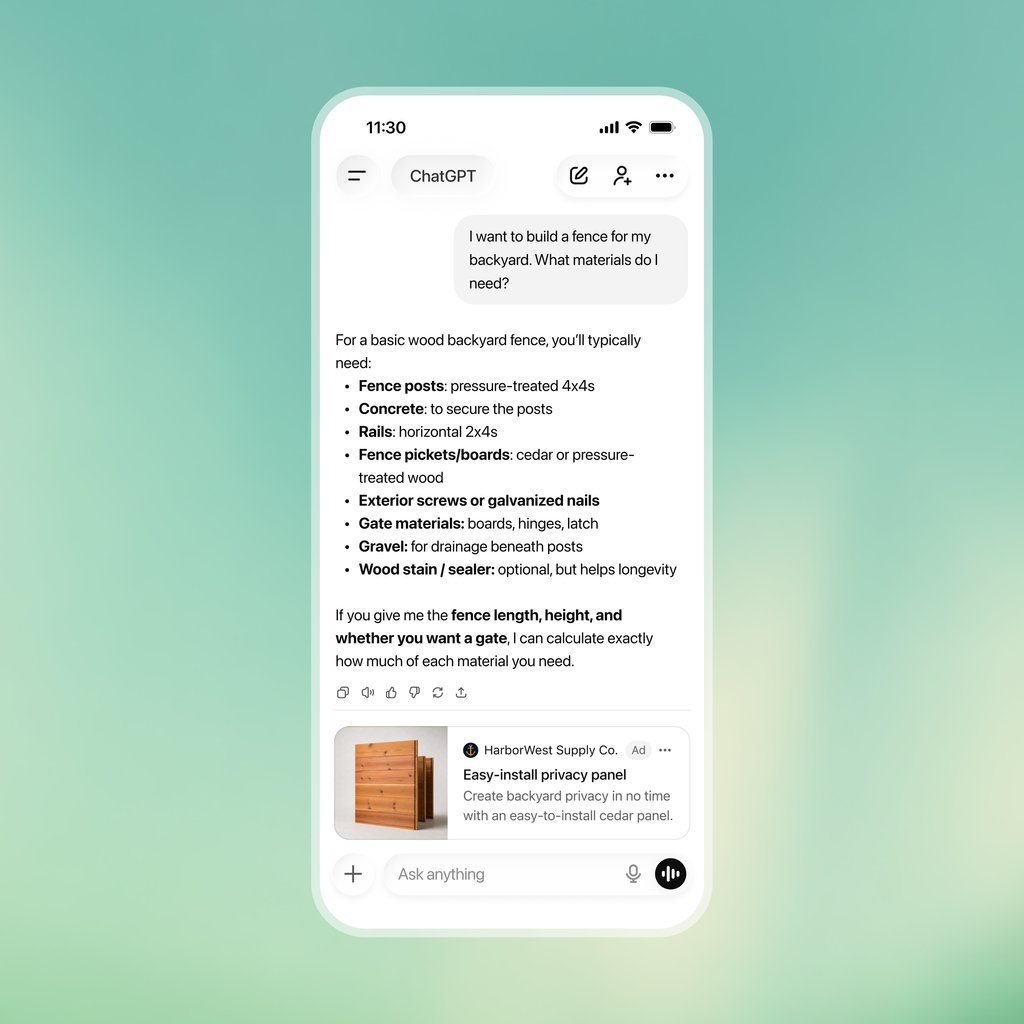
The standard format appears beneath ChatGPT’s answer and includes the advertiser’s name, logo, a headline, body text, an image, and the landing page. There are also catalog-based campaigns, aimed at e-commerce.
The format keeps changing fast. AdExchanger describes how the ads went from a shaded box with a prominent “sponsored” label to a boxless design with the label off to the side. In October, OpenAI introduced a format with larger images for people using ChatGPT to generate images, first being tested in the United States.
How ChatGPT decides which ad to show
There’s no exact-match keyword buying. The system chooses based on the context of the current conversation, the content of the ad and the landing page, and “context hints” that the advertiser uploads at the ad-group level. According to OpenAI, these hints can describe conversations, topics, or keywords where the product would be relevant, but they guide placement without acting as an exact match or guaranteeing the ad will appear in a given conversation.
If the user has personalization turned on, the system can also use signals from past chats, ChatGPT’s memory, and how that person interacted with other ads.
Selection runs through a second-price auction weighted by relevance. A more relevant ad can beat a higher bid.
How to buy ads on ChatGPT: access, objectives, and budget
There are two routes. The first is Ads Manager, the self-serve platform at ads.openai.com. The second is going through OpenAI’s sales team, partner agencies, or technology partners, aimed at large advertisers.
To use self-serve, the company advertising and paying has to be based in an eligible country. The availability list, updated the same day as the announcement, already includes the 16 Latin American markets.
There’s one restriction that matters in the region: some new accounts can initially only advertise in their home country. According to the help center, an account becomes eligible for other countries once it passes identity verification and reaches a required spending threshold on local campaigns. OpenAI doesn’t publish that figure. An agency in Buenos Aires looking to launch a regional campaign for a client could find itself limited to Argentina at first.
Every campaign picks one of three objectives:
- Views (CPM). You pay per thousand impressions.
- Clicks (CPC). You pay per valid click. OpenAI recommends starting with a maximum bid of US$3 to US$5 per click.
- Conversions. The system optimizes toward a conversion event, but billing is per click (oCPC) or per thousand impressions (oCPM). There’s no pay-per-conversion option yet, though Digiday has reported that OpenAI is developing cost-per-action bidding.
OpenAI doesn’t publish benchmark prices by market. What’s out there is data from agencies and practitioners, which is best read as rough estimates:
- Brazil. The agency Marktech reported aggregated campaign data between August 13 and September 22: R$2.40 per click, R$32.05 per thousand impressions, and a 1.33% click-through rate. CPC went from R$1.03 to R$4.09 and dropped to R$2.49 in the sixth week.
- Mexico. A practitioner published results from a small campaign with a cost of MXN 14.83 per click. That’s a single case.
- United States. According to Digiday, CPM started around US$60 and by April was hovering around US$45 or less.
There’s no data yet from the 14 markets that opened today. The Brazilian curve shows that the price in the first few weeks isn’t the steady-state price.
The minimum daily budget is US$25 per campaign, MXN 150 in Mexico, and BRL 40 in Brazil. OpenAI’s table doesn’t yet include currencies like the Argentine, Chilean, or Colombian peso, and OpenAI doesn’t clarify what currency it bills accounts in those countries.
The daily budget is a weekly average. On any given day a campaign can spend up to double the amount set, but over seven days it won’t exceed seven times the daily figure.
Targeting and measurement
You can target by country and, where available, by region, city, or zip code. You can also target by platform: Android app, Android web, desktop web, iOS app, and iOS web. Catalog campaigns only support country-level targeting.
Custom audiences for inclusion require a minimum of 25,000 matched users. Smaller lists can be used for exclusion. In the region’s mid-sized markets, hitting 25,000 matches can be a challenge.
Reports show impressions, clicks, spend, click-through rate (CTR), average CPC and CPM, and conversions if you set up measurement in Ads Manager. You can also add UTM parameters to URLs to track traffic in your analytics tool. Spend data can show up with a seven- to eight-hour delay.
Measurement is the weak spot, though it’s improving. On October 5, OpenAI added integrations with attribution partners like AppsFlyer, Adjust, Branch, and Northbeam, geo-based incrementality testing with Haus, Measured, and WorkMagic, and brand-safety evaluation pilots with DoubleVerify and Integral Ad Science. AdExchanger reports that many advertisers are waiting for more robust tools before increasing budgets.
What can’t be advertised, and where ChatGPT Ads don’t appear
According to the user help center, ads don’t appear near sensitive topics, such as personal health, mental health, or politics. The ad policies currently prohibit political advertising, which includes candidates, parties, elections, public-policy issues, and social issues framed as debate.
For Latin America, the rule that carries the most weight is in those same policies: outside the United States, ads for health services and financial services are generally banned, and legal services ads are banned outright. Case-by-case approvals for those categories apply only in the United States. A bank, a fintech, or a regional health insurer generally can’t advertise, and a law firm can’t for now. Financial tools that don’t promote financial products, like a budgeting app, generally can.
The policies state that at this stage, ChatGPT Ads are concentrated in a limited set of consumer categories: home goods, local services, travel and entertainment, digital products, and education. Also banned, among others: alcohol, tobacco, gambling, adult content, and individual job or property listings. Some qualified advertisers can upload negative keywords to avoid contexts they don’t want.
Privacy and user controls
OpenAI says advertisers never receive chats, chat history, memories, the user’s name, email, precise location, IP address, or sensitive information. The system can use general location and language to decide which ad to show.
Free and Go users have an ad controls section in settings, where they can:
- Turn off personalization. They’ll still see ads based on the current conversation, but not on past chats or memory.
- Hide or report an ad.
- See why they were shown an ad.
- Delete the data used to select ads.
Deleted ad data is removed from servers within 30 days. Ad interactions aren’t stored in ChatGPT’s memory, and temporary chats don’t show ads.
Personalization may come turned on by default. Folha de S.Paulo reported that in Brazil it was on by default at launch. Anyone who doesn’t want to see ChatGPT ads without paying has the option of an ad-free Free tier, in exchange for fewer messages per day and no access to tools like image generation or deep research.
What changes for a brand in Latin America
Three things:
SEO still matters
What ChatGPT recommends in its answer can’t be bought, and the ad appears below it. We’ve written about how assistants choose which brands to mention in our analysis of agentic search.
The ad should feel like a continuation of the conversation, not an interruption
The ad has to work as a continuation of the conversation, not as an interruption. If someone is comparing options, a generic brand message competes poorly against an answer that already solved their doubt. Context hints and the landing page carry weight in the selection, so they need to be written for the user’s specific situation.
Start small
The first test should be small and measurable. With limited inventory, incomplete measurement, and accounts starting out restricted to their home country, the sensible approach is one campaign per market, with UTMs and a click objective, before shifting budget away from other channels.
The boring explanation
ChatGPT has advertising for the same reason free email and search engines do: most users don’t pay, and someone has to cover the cost of serving them. OpenAI puts it this way: advertising helps sustain free and low-cost access. That’s why ads are on Free and Go and not on the paid plans.
The rapid expansion follows a similar logic. An auction system needs a lot of advertisers competing for prices and relevance to work properly. Opening 26 countries at once, with self-serve access and low minimum budgets, is the most direct way to add supply. AdExchanger notes that Brazil already accounts for the third-largest share of ChatGPT visitors, behind the United States and India.
What to watch
- Currencies and categories. Whether OpenAI adds Argentine, Chilean, or Colombian pesos to its budget table, and whether it allows banks and fintechs—two of the region’s biggest advertisers—outside the United States.
- Measurement. OpenAI has signaled new formats, objectives, and buying options are coming. Incrementality testing is still at an early stage, and without reliable attribution, big budgets won’t follow.
- The label. The format has already lost its box. If the separation between answer and ad keeps shrinking, the promise that ads don’t influence answers will matter less than what users actually perceive.
- In-chat purchases. OpenAI says it’s exploring more native ways for companies to interact with users, and L’Oréal’s testimonial in the announcement mentions “agentic commerce.” If purchases start happening within the conversation itself, the ad stops driving traffic to your site and starts competing for the sale directly.
For a Latin American brand, the most concrete consequence arrives before any of that: as of today, a competitor can pay to appear right below the answer that recommends you.