
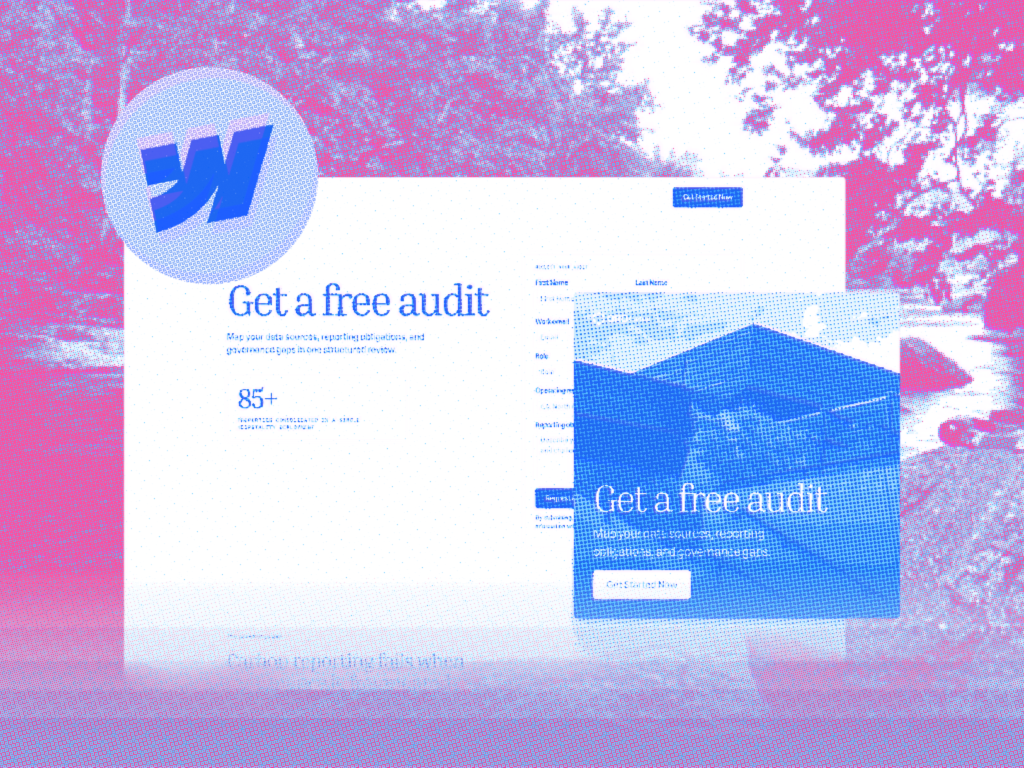
Webflow now wants to run your campaigns end to end. On October 20, 2026, the no-code web development platform launched Campaigns, a product with AI agents that covers the entire journey: from brief to landing page, audience variants, ads, and pipeline measurement.
Beyond Webflow itself, this move matters because it signals that one of the leaders in the no-code space is betting on moving beyond website creation. Are we looking at a vertically integrated Webflow that can compete head-to-head with platforms like HubSpot?
The Campaigns beta was unveiled at Webflow Conf this past September 2. In its launch post, the company describes it as “a standalone tool” that works alongside the main site, “whether it’s running on Webflow or another CMS.”
How does Webflow Campaigns work?
Webflow Campaigns covers ad campaigns—but it also wades into design system governance.
The product works roughly like this:
An agent extracts the site’s visual identity and turns it into a design system in DESIGN.md, a plain-text format meant to help agents follow a brand’s rules. The format isn’t Webflow’s own: Google Labs created it for its design tool Stitch and published the specification as open source on April 21, 2026.
Campaigns generates landing pages, variants by persona, industry, or account, each with its own URL, plus ads carrying the same message. It connects with Marketo or HubSpot forms, builds Performance Max campaigns for Google Ads, measures pipeline with HubSpot and Salesforce, and offers AI recommendations on what to improve. It can also be operated from tools like Claude through Webflow’s MCP, its connector for agents.
The easy read is that Webflow is bolting on AI so as not to fall behind. The more useful detail is that the product doesn’t require migrating your site to Webflow. You can keep managing your site with the tool of your choice—in fact, in the launch post, Webflow highlights the testimonial of a Marketing Operations Manager who uses Webflow Campaigns alongside WordPress. But in her case, Webflow isn’t just an add-on—it replaced something. It replaced a long, tedious workflow that involved mocking things up in one platform and then implementing them in WordPress.
Our take
For nearly two decades, the website was the destination and the builder sold you the tool to make it. Now the scarce resource is the speed to launch and iterate campaigns, and every layer of the marketing stack is being rebuilt to manage that cycle with agents. Unless they prove particularly successful, individual pages become disposable products. What endures is the brand system and the data on what actually converted.
Why now?
According to a study by Aleyda Solis using Similarweb data, published by Search Engine Land, between January 2025 and January 2026 classic organic results lost between 11 and 23 points of click share, while text ads gained between 7 and 13. The study covers only four consumer categories in the United States (headphones, jeans, greeting cards, and online games), while Campaigns targets B2B demand gen teams working with pipeline, ABM, and Marketo. There’s no equivalent data for B2B. But the direction is clear: when organic performs worse, budget shifts to paid, which needs landing pages and ads fast. It’s the flip side of our analysis on agentic search.
Who controls what?
Every competitor is betting that its own layer is the one that calls the shots. Meta is betting on media: at Advertising Week, according to MediaPost, it’s testing an assistant that plans and creates campaigns and adjusts targeting and budget. Google is both partner and rival: Campaigns publishes to Google Ads and uses its design format, but from Labs, Google offers Pomelli, which builds a brand’s “Business DNA” and generates sites. HubSpot is betting on the CRM with Marketing Studio’s campaign agent, currently in beta. Adobe is betting on creative with GenStudio for Performance Marketing.
Webflow is betting that whoever holds the brand system and the landing page holds the cycle, even if final measurement depends on other platforms’ media. That’s why everyone is trying to extract brand identity on their own terms: Webflow from a URL, Google with Pomelli, Meta from advertiser data.
What we don’t know
Campaigns can already be purchased, but it has no published pricing: Webflow invites you to request a demo. The only integrated ad channel is Google Ads. The promise of going from weeks to hours comes from Webflow itself, and the example of Kate Johnston, its head of demand gen, who launched a complete paid campaign in under an hour, is an internal case study.
What’s more, a brand system rebuilt from a single page is an approximation. And if generating content becomes cheap, the bottleneck shifts to review.
The boring explanation
Webflow needs to grow beyond websites. That’s true, and it doesn’t contradict the thesis: the fact that five companies starting from different places are converging on the same workflow is itself the signal. What could complicate this reading is if teams end up using these tools only for one-off landing pages while still coordinating the campaign elsewhere.
What to watch
Campaigns’ pricing and billing model. Whether it adds ad channels like LinkedIn or Meta, key for B2B. Whether DESIGN.md becomes the standard across platforms: since the brand system is already born in an open, portable format, no platform can use it to lock in customers, and competition shifts to conversion data. And whether agencies start selling campaigns at a fixed price on top of these platforms. For them, producing landing pages and variants is the most exposed line of work, as we laid out in our guide on productized services. What’s left to sell is the brief, the brand system, and the judgment to review it all.