
For the past year, without anyone quite noticing, two financial crises have been brewing in two countries widely seen as among the most business-friendly in the region: Chile and Paraguay. Each with its own strategy for managing its public image. In both cases, the scandals have had, and will continue to have, political reverberations for years. In both cases, the private sector finds itself under scrutiny.
How do these scandals ripple out across the rest of the fintech/startup/entrepreneurial ecosystem? Let’s look at three variables: legal and financial infrastructure, economic indicators, and a bit of politics.
A summary of the Ueno Bank crisis
Ueno Bank was a neobank that received its operating license in 2023, and starting in 2024 it rose meteorically thanks to hyper-aggressive marketing, government benefits, and an acquisition. Sixty percent of Paraguayan adults had an account there. Even so, people weren’t necessarily parking large sums of savings in it—it mostly served as the rail through which everyday transactions from middle- and lower-income households ran. It functioned much like Mercado Pago does in Argentina.
Here’s roughly what happened over the past few days:
- November 2 – Paraguay’s Central Bank orders the intervention of Ueno Bank over insolvency, after months of reports and questions.
- November 3 – the bank’s assets and services are frozen. The first protests begin, and they continue to this day.
- November 5 – the president of the Central Bank resigns, and the Deposit Guarantee Fund begins reimbursing affected savers.
- November 6 – Paraguay’s President, Santiago Peña, is removed from office.
The market says the macro picture is safe
As of today, I think the market is saying two things:
1. The country’s biggest bank broke, but the country didn’t.
The first macroeconomic consequences of the Paraguayan affair are serious for the country, but far milder than you’d expect by Latin American standards. The dollar spiked… 10% (I’m Argentine, where that’s known as “Tuesday”), and country risk rose 21%—but only up to 145 points, nearly ten times lower than Argentina’s, for example. Country risk is likely pricing in a state that has lost access to part of its annual revenue, frozen by the bank’s collapse—losses have been estimated at between $850 million and $1.2 billion.
2. On the consumer side, there’s a new demand for a less concentrated market.
The most striking figure, to me, is the rise in USDT’s price relative to the dollar in Paraguay. Unfortunately, we can’t track systematic buy-sell data in an open market—we can only track listed offers on p2p platforms, without necessarily knowing whether those offers were actually fulfilled. But a USDT offered at a higher price than the dollar signals demand to exit the system.
How is Paraguay’s financial infrastructure responding?
To start, the Central Bank of Paraguay’s Deposit Guarantee Fund began paying back affected customers on the second day of the crisis. Still, this is a slow process, and only time will tell whether all outstanding debts get settled.
Meanwhile, Congress denied Peña’s resignation so he couldn’t claim lifetime immunity, and later opened impeachment proceedings that led to his removal. In other words, the institutional response was relatively effective. The problem, though, is how the crisis came about in the first place. The Ueno Bank case can be read as an example of systemic corruption between the corporate sector and politics. After all, it was blatant that Peña held shares in a bank that received state contracts and benefits. There are also broader institutional problems tied to credit rating agencies, which assigned the first-ever BB rating to a Paraguayan bank. What’s left to account for in that rating, given that the institution was declared insolvent just a year later?
None of this means Paraguay’s financial infrastructure is some kind of model system. It doesn’t yet have the regulatory sophistication of countries like Chile. Interoperability, for instance, is a recent development, and its startup sector—which would be the engine of innovation—is still in its infancy.
Paraguay’s nascent fintech sector
Even though it lags well behind startup hubs like Brazil and Argentina, Paraguay is fertile ground for entrepreneurship, and it’s long had more financial startups than banks. This is a country whose strategy for international positioning hinges on being a Mercosur trading hub along the tri-border routes. Through Ciudad del Este, one of the most freewheeling cities in the world, all kinds of goods move—electronics, textiles—along with crypto, reais, and guaraníes. Trade that is simultaneously informal and international, carried out across multiple languages, forces anyone operating there to level up fast on the product side.
Some data points:
- Historically, Paraguay’s credit ecosystem has been driven by cooperatives, especially in rural areas.
- The great historical opportunity was that, as of 2021, half of all adults were unbanked.
- Only in 2025, through Law 7503/2025, was the National Payment System created, through which the Central Bank formally recognized all the non-bank entities that had been operating in a legal gray zone.
- Law 7572/2025 reformed the securities market and, among other things, recognized the blockchain tokenization of real-world assets, such as grain.
- The main vertical is payment infrastructure.
But what was being said about Ueno Bank before everything blew up? What place did this promising startup hold in Paraguay’s fintech ecosystem? This neobank didn’t grow organically—it’s not a typical bootstrapped startup story. Even so, its pitch was the same as the rest of the sector’s: financially include everyone left out by the traditional banking system. And in the narratives told by major institutions, it was framed as the country’s potential unicorn.
We can also think of this crisis as an initial market correction. Every young industry has its flops—whether from corruption, overleveraging, or harmful products. Think of the dot-com crash, the current state of the AI industry, or the maritime exploration companies of the eighteenth century.

What crisis does this crisis resemble?
In the Argentine press and on the Argentine internet, we have a habit of comparing any financial mess to the 2001 corralito, which took down both the financial system of the time and the ruling party along with it. It’s true that here, too, the economy was rattled because one of the banks most heavily used for everyday transactions went down—but the whole system didn’t come apart.
What’s more, this crisis had an effective institutional resolution and was more of an isolated incident than a systemic one. Under those terms, I’d propose comparing it to the more recent and contemporary crisis around Chile’s AFPs (pension fund managers): a specific crisis stemming from executives making risky—not to say shady—decisions that ultimately turned out badly. For whom, exactly, varies.
In the Chilean case, playing the spread on U.S. interest rates was wildly profitable for a year, and who wouldn’t want to hit and exceed their profit targets? With Ueno Bank, we have a more classic case of corruption: the president took steps to benefit an institution in which he had, until shockingly recently, held shares. The Chilean case damages the standing of a pension system that, for years, broad segments of society have felt needs root-and-branch reform; the Paraguayan crisis could mark a turning point in the relationship between citizens, the state, and retail financial providers (a.k.a. fintechs).
For the fintech world, this is a crisis—but an image crisis
I’d argue this is a crisis that trickled down from the top, since it stems from a case of corruption in the upper echelons of Paraguay’s formal economy and political system. In fact, the way this episode is being framed is as a political problem, not a market one.
That said, given that:
- Ueno falls squarely within the neobank/fintech universe
- its customer base skewed toward SMEs and retail clients, with relatively few high-net-worth accounts, and a heavy concentration of state assets, including pension system funds.
- the need for fintechs isn’t going anywhere, in a country whose economy is almost idiosyncratically informal (55-60%),
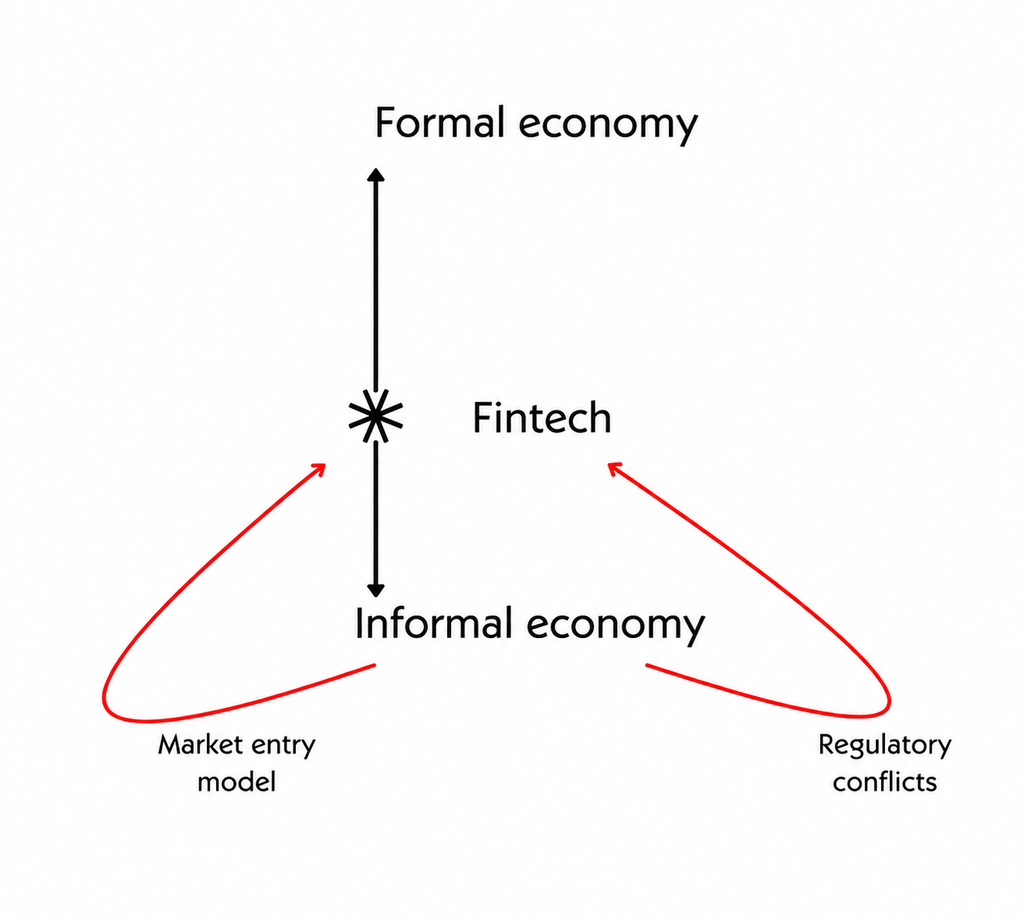
I believe there are two big boomerangs that could come back to hit the fintech world in the medium or long term: the market entry model and more contentious regulatory frameworks.
A more scrutinizing consumer
Offering tools for the informal economy is one of the most common market-entry models for fintechs in the developing world: absorbing the liquidity flows that banks, for various reasons, have historically ignored, and providing the technological leap from cash to real-time financial management, credit access, digital collections, and so on. That’s the case for Mercado Pago; it’s the case for Ueno Bank.
For now, we can only speculate about how deeply narratives about fintechs will permeate among Paraguay’s middle- and lower-income public. What will they look at when choosing a bank? What opportunities might open up around managing one’s own assets—for instance, might the concept of the crypto cold wallet suddenly make sense again?
We can tentatively conclude that the crisis of confidence isn’t really about Paraguay as a state (or at least, that depends on whom you ask) but rather about a specific alliance between its political class and its financial system in recent years. The challenge for mainstream players (other banks, other politicians) will be to isolate Peña and Grupo Vázquez from the rest of the system—in other words, a strategy of rotten apples versus fresh ones. But emerging players may have a chance to argue that it’s the tree itself that’s rotten.
Rules, damned rules
That reading is an extrapolation from how I see the Chilean AFP crisis, where: 1) the private pension management system has been under critical scrutiny from the progressive agenda for many years, and 2) progressivism is a majority governing force.
The Paraguayan case is the opposite: the Ueno Bank affair didn’t necessarily strike such a specific partisan nerve. After all, any party can rally against corruption. Paraguay, moreover, is politically hyper-cohesive, having never really had a center-left government, aside from Lugo’s cut-short term.
What am I getting at with this sudden foray into electoral sketching? That there’s almost no chance of a radical shift in Paraguayan policy. BUT, if public scrutiny of the financial system manages to shift from a consumer decision into a demand for stricter regulatory frameworks, there could be room for change under some new governing force. For now, these are speculations, especially given the institutional response the case has already received.
Wrapping up
Paraguay proved it can maintain solid institutions in the face of an apparently flagrant case of corruption that triggered a financial crisis. Whether this crisis marks a turning point in how Paraguayan society manages its assets will depend, in part, on the product decisions the ecosystem makes next.

By Santiago Medina
Frequently asked questions
What happened with Ueno Bank in Paraguay?
Paraguay’s Central Bank initiated resolution proceedings against Ueno Bank over solvency issues. The move restricted customers’ access to their deposits and triggered a crisis with both economic and political fallout.
How can Ueno Bank customers get their money back?
Deposit reimbursements are being channeled through the Deposit Guarantee Fund and the bank’s resolution process. That doesn’t mean every customer recovers all of their money at once: timelines and amounts depend on applicable coverage limits and how the process unfolds.
Does Ueno Bank’s collapse mean Paraguay’s entire financial system is in crisis?
Not necessarily. The article distinguishes between the problems of a single institution and a system-wide crisis. Although the impact on customers and everyday transactions was severe, the macroeconomic indicators analyzed suggest a more contained reaction than seen in other Latin American financial crises.
How does the Ueno Bank case affect Paraguay’s fintechs?
It could increase user distrust and intensify scrutiny of the ties between financial institutions and the state. For fintechs, the challenge will be demonstrating how they protect customer funds, who oversees their operations, and what guarantees they offer.
Why does financial inclusion matter in this case?
Ueno Bank served users who relied on it for everyday payments and transactions, in a country with an extensive informal economy and real banking needs. Its collapse undermines trust in digital financial services, but it doesn’t eliminate demand for tools to collect payments, make payments, and access credit.
Could the Ueno Bank case lead to regulatory changes?
It’s a possibility, though not yet a certainty. The article suggests that public distrust could translate into demands for greater oversight and stricter rules. How far those changes go will depend on the political and institutional response.
What opportunities does this crisis create for other fintechs?
Other companies could differentiate themselves through greater transparency, better protection of funds, and tools that give users more control over their own money. These are possible opportunities: whether they materialize will depend on how consumer priorities shift and on the product decisions the sector makes.