
Use it to concentrate a launch you already know how to distribute. Do not use it as a substitute for distribution.
Decision summary
Launch on Product Hunt when you have a live, self-serve product, a clear first-use moment, and a channel to continue the conversation after launch day. It is a poor fit for products that require procurement, a long sales process, or a founder to explain the value before a buyer can act.
Product Hunt itself describes the platform as a community of makers and early adopters. That is the useful mental model. A launch can produce feedback, attention and a durable public artifact. It does not turn an unclear product or an absent audience into demand.
Who should launch, and who should skip it
| Fit | Why | First condition to check |
|---|---|---|
| Self-serve SaaS, developer or design tools | A stranger can understand and try the product quickly | Can someone reach a meaningful first action without a sales call? |
| A significant new release | Product Hunt permits repeated launches for meaningful iterations | Is the release materially different from the last one? |
| Teams with an owned audience | The launch can extend an existing conversation | Can you bring people to comment, test and follow up? |
| Enterprise, services or regulated sales | The buying motion rarely fits a one-day public leaderboard | Is the real buyer present and able to buy? |
| Products still looking for basic product clarity | Public traffic magnifies an unclear proposition | Can the landing page explain the product in one sentence? |
The platform’s current featuring guidance is explicit that featured products should be digital, live and ready for use, with usefulness, novelty, craft or creativity as the relevant qualities. That rules out a familiar failure mode: treating a Product Hunt page as the place to discover whether a product exists.
The operating model: a launch is an attention concentrator
A Product Hunt launch works when four things arrive together: a product someone can try, a legible promise, a maker who can answer questions, and a follow-up path. The ranking is a visible output of that activity, but it is not the operating goal.
Product Hunt’s own launch material recommends that makers submit their own product, prepare the launch, and use comments to tell the product story. Its definitions page says 70% of products that achieved Product of the Day had a maker’s first comment. That is a platform observation, not a promise that a comment produces a result. It does show where the work belongs: in the product and the conversation, not in buying votes or hiring a ceremonial hunter.
The boring explanation for a weak launch is usually not an algorithmic penalty. Most teams have asked a public page to do work that belongs upstream: positioning, product readiness, audience development or conversion design.
Prepare the decision before you prepare the page
Assign one accountable owner for the launch and one for conversion. Those are often different people. The launch owner runs the page, comments and schedule. The conversion owner owns the landing page, signup path, attribution and follow-up. If neither owner exists, postpone the launch.
Prepare a real product page, a short demonstration, images that show the work rather than brand decoration, and a maker comment that explains why the product exists and what it does. Product Hunt says makers can submit directly, and its current guidance says the best launch day is the day a team is most prepared. It also identifies 12:01 a.m. Pacific as useful for makers who can plan ahead.
Set the goal before the day begins. Possible goals include learning from a defined cohort, collecting a specific kind of feedback, testing a new positioning line, building followers for future releases, or converting traffic into trial starts. “Reach number one” is a ranking ambition, not a business objective.
Run the launch as a conversation, then keep the audience
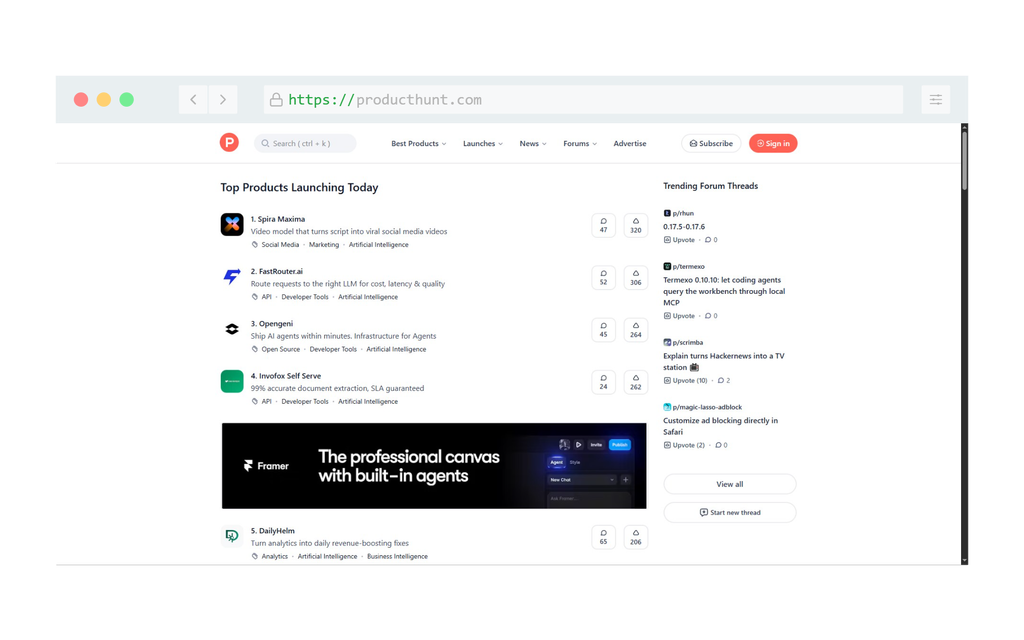
On launch day, the maker should be present. Respond to questions with product detail, record recurring objections, and treat criticism as research. Product Hunt prohibits directly asking people to upvote; invite them to visit, comment and judge the product for themselves.
The next step matters more than the leaderboard. Tag launch traffic, capture the acquisition source, and compare its activation and retention with the rest of the week’s cohort. A Product Hunt visitor who signs up and reaches the first useful action is more informative than an unsegmented visit total.
Follow up while the context is fresh. Publish answers to recurring questions, turn serious feedback into a product or documentation decision, and give people a reason to follow the product beyond the first day. Product Hunt’s forum guidance says product-forum posts notify followers. That makes the launch a potential starting point for an owned relationship, provided the team has something useful to say afterward.
Metrics and stop conditions
Use three levels of measurement.
| Level | Measure | Decision it informs |
|---|---|---|
| Leading | Product-page completion, comments, first-use activation | Is the promise and onboarding legible? |
| Outcome | Qualified signups, activated users, retained cohort | Did attention become product value? |
| Strategic | Repeatable channel learning, follower growth, reusable proof | Should this become part of the launch motion? |
Do not set a universal visitor, upvote or conversion benchmark. Results vary with category, audience, pricing, product maturity and the definition of a signup. A team with prior launches can use its own historical cohort as a comparison. A first-time team should define a minimum learning goal, such as twenty qualified conversations or a clear activation reading, rather than invent precision.
Stop treating the channel as strategic if it repeatedly produces public attention without activation, if the work distracts from a higher-intent motion, or if the team cannot turn feedback into product changes. Run a second launch only for a significant iteration; Product Hunt’s relaunch guidance names examples such as a new mobile app or a complete redesign.
Failure modes and alternatives
The bad version of a Product Hunt launch is a one-day campaign built around a ranking target. It encourages vote-seeking, generic copy and a scramble for traffic that the product cannot convert. It also makes a middling position feel like evidence of a bad product, which it is not.
If the product needs evaluation rather than public attention, run a design-partner program. If the buyer is a developer, publish a technical artifact that proves the claim. If the buying motion is enterprise, use a named-account or partner launch. If the goal is positioning, interview prospective customers before paying for launch assets.
What to do this week
- Write the decision owner, desired learning and stop condition on one page.
- Test whether a stranger can reach the product’s first useful action without help.
- Build the launch page and attribution before inviting anyone.
- Ask a small group of relevant users to review the promise, not to manufacture votes.
- Schedule a review of activation, feedback and follow-up work for the week after launch.

By Circe Galanternik
Frequently asked questions
Is Product Hunt free to use?
Yes. Product Hunt says launching is free. Budget is still required for the product work, creative assets and the people who will operate the launch.
Do you need a hunter?
No. Product Hunt encourages makers to submit their own product and says there is no discernible advantage to a third-party hunter.
Can you relaunch a product?
Yes, when there is a significant iteration. A new mobile app or a complete redesign are examples in Product Hunt’s current guidance.
Does a Product Hunt launch guarantee distribution?
No. The platform offers access to a relevant community, not a guaranteed commercial outcome. Measure the product response and the cohort that follows, not rank alone.
Glossary
Activation: the first behavior that shows a new user received the product’s promised value.
Owned audience: people a company can reach directly, such as email subscribers, customers or product followers.