

Looking for a rental in Buenos Aires is rough. Not only are we at a historic low in the real estate market, but the search platforms (Zonaprop, Argenprop and other sad etceteras) seem to run on Windows 95. Some alternatives have popped up lately, but finding a place to rent today is torture. A coworker told me: “I found the place I rent using Claude”, and it didn’t take me long to start playing with prompts and a skill to find myself a rental until, thanks to our new best friend, I found a place. Now I have to figure out how to pack my life into boxes, something an AI agent still can’t do (I insist: still).
For twenty-five years, searching the internet worked the same way: you typed something, a machine returned a list, and you did the rest. You clicked, compared, opened twelve tabs, closed nine, and bought from the one that didn’t ask you to create an account.
That last part is changing. In 2026, the machine started doing it too. You’re no longer stuck in loops of searches and tabs; instead, someone is searching for you, and that someone is a projection of you in the digital world. Say hello to AI agents.
From “ten blue links” to “figure it out yourself”
It happened gradually. First came featured snippets, which answered the question right there on the results page. Then came AI Overviews, which write out a personalized answer, with the ability to even keep the conversation going with the user without leaving the SERP. According to Pew Research, when an AI summary appears, people click on a traditional result in only 8% of visits, compared to 15% when it doesn’t.
Agentic search is the next step, and it’s a bigger one. The question stops being “what’s the best karaoke place nearby?” and becomes “book me a private karaoke room for six on Friday, somewhere that serves food late.” Google used that exact example at I/O 2026: it’s clear Alphabet isn’t rolling the dice here; maybe AI agents are actually on our side.
What is agentic search?
Agentic search is a search in which an AI agent acts on the user’s behalf: it searches, compares options, and completes tasks like booking, calling, or buying, instead of just returning results or answers. If Google was the phone book, the little bot is your travel agent, your personal secretary: your own Moneypenny.
It’s agentic AI applied to search. Under the hood, the agent does in seconds what used to take us an afternoon: it breaks the request down into steps (“room for six,” “Friday,” “food available late”), checks several sources at once, rules out what doesn’t fit, compares prices and availability, and, if you gave it permission, books or pays.
To do that, it reads the web differently than we do. It goes straight for the data (hours, prices, stock, reviews, cancellation policies) and skips the “nice photos” and “clever copy” (though, did we ever really pay attention to those either?)
Here’s how the shift looks compared to what came before:
| Classic search | AI answers | Agentic search | |
|---|---|---|---|
| What you get | A list of links | A written answer | A completed task |
| Who does the work | You | You, with help | The agent |
| What a brand needs | To rank | To be cited | To be chosen |
The rest of this post is about that last row.
Agentic search at Big 2026: news from the front lines.
As much as we keep repeating like a mantra that “we’re in a wild west era,” the big players are moving extremely fast. Without further ado:
- Google Search added agents. At I/O 2026, Google announced agentic bookings for local services, agentic calls (the search engine calls businesses for you), and “information agents” that monitor the web. Most of it launched in the United States by mid-year.
- Shopping now has a protocol. In January, at the NRF trade show, Google and Shopify launched the Universal Commerce Protocol (UCP), with partners including Etsy, Wayfair, Target, and Walmart. It lets agents complete purchases inside AI Mode and Gemini.
- The traffic is real, and it converts. Adobe Analytics analyzed more than a trillion visits to US online stores. Traffic arriving from AI grew 393% year over year in the first quarter of 2026, and in March it converted 42% better than other traffic. A year earlier, it had converted 38% worse.
- The forecast for the holidays. Adobe expects that traffic to grow another 130% this season.
Adobe also notes that AI traffic is still “modest in total volume” compared to other channels. It’s a small channel, but it’s growing fast, and the visitors it sends convert. Worth remembering: not long ago, the most hated tech giant in the industry bought SEMRush, an SEO leader and, alongside Ahrefs, one of the main players in the web-traffic SaaS market for basically forever.
Agentic commerce: what hasn’t worked yet
Not every launch went well. In September 2025, OpenAI launched Instant Checkout in ChatGPT and promised to add more than a million Shopify merchants. By early 2026, analysts counted around 30 active ones. Prices and stock were often outdated, and many shoppers didn’t want to hand their card over to an agent. In March 2026, OpenAI backtracked: purchases are now completed on each merchant’s own site.
An agent is only as good as the data it can read. If prices or stock are outdated, it can’t close the sale. If there’s JS or CSS the agent doesn’t want to deal with because it prioritizes reading HTML, a valuable result gets lost.
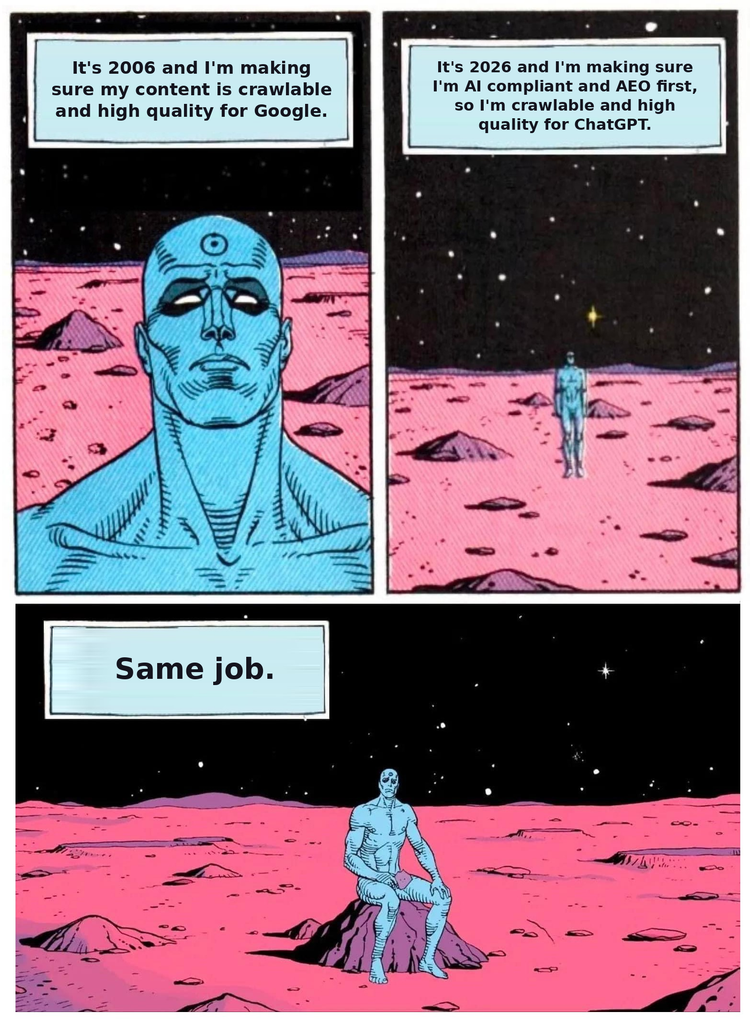
Does any of this sound familiar? It’s almost like… are we talking about E-E-A-T and crawlability all over again?
Why agentic search is, first and foremost, an SEO issue
There’s a temptation to treat agentic search as something entirely new, requiring a whole new playbook (and a whole new agency). We disagree.
Adobe measured how readable online stores are for AI: on average, about a third of the content on product pages isn’t accessible to machines. Fixing that requires crawlability, structured data, and good site architecture, which is just the basics of technical SEO. It’s also why we keep insisting that search now happens everywhere, not just on Google (more on search everywhere optimization).
I’ve worked in SEO for years, and I have to insist: above all, what the user (virtual or not) is looking for is credibility, clarity, and a bit of magic (the reward-candy that comes with the purchase). The technical side is still the floor. If an agent can’t read your site, you don’t exist. But once it can read you, what decides whether it chooses you is what you say and how you say it: a clear offer, concrete proof, and a story that can be repeated. In that sense, SEO becomes a much more editorial job than we ever imagined. It’s time we owned our creative side.
How to get an AI agent to choose you
If the job used to be “ranking” and then became “getting cited,” now it’s “getting chosen.” That means:
- Being readable. Server-rendered content, clean HTML, nothing important hidden behind scripts or tabs. If a crawler can’t see it, an agent can’t use it.
- Being structured. Schema markup for products, prices, availability, reviews, services, and locations. Agents compare things, so you need to give them something to compare.
- Staying up to date. Live feeds beat scraped pages. The Instant Checkout affair we described above is a warning about stale data.
- Being clear about the offer. Price, what’s included, and who it’s for. Vague pages lose to specific ones.
- Getting talked about. Agents rely on mentions, reviews, and third-party comparisons, so your reputation off-site is now also part of your “page.” It’s one of the reasons we think branded media is going to matter a lot more.
Agents don’t care about vibes: they read claims
For marketing, this changes what a brand needs to say.
For years, a good chunk of marketing ran on mood: a pretty landing page, a clever line, a feeling. Agents don’t care about mood. They read claims: what you do, for whom, at what price, and with what proof. A brand with a fuzzy story is invisible to them.
Good marketing never actually depended on mood. Our job as modern advertisers is to make the right search happen: to get a person to what they need, and maybe even to what they love. Agentic search cuts out a lot of the noise between those two things.
At Postdigitalist, we do narrative engineering, which is a fancy way of saying that we organize what a brand has to say until it explains itself. We used to do that for a person scrolling. Now we do it for robots. Which is to say, we do it for a person scrolling.
I found my new apartment with an agent’s help. Our job is to make sure your customers find you just as fast, and that their agent is clear on why it should choose you.

By Circe Galanternik
Frequently asked questions
What is agentic AI?
It’s AI that can plan and execute multi-step tasks to achieve a goal, like searching for options, comparing them, and buying. Agentic search is one of its applications.
Is agentic search the same as AI search?
Not quite. AI search answers the question. Agentic search acts on it: it books, calls, compares, or buys on your behalf.
What’s the difference between agentic search and agentic commerce?
Agentic commerce is agentic search applied to shopping: an AI agent finds a product and completes the purchase, often through protocols like Google’s UCP.
Do I need a new strategy for agentic search?
A sharper version of the one you already have: a site machines can read, structured and up-to-date data, a clear offer, and a solid off-site reputation.
Does your brand read equally well to a person and to an agent?
If you want to get your story in order so both can read it and choose it, that’s what The Program, our brand strategy sprint for founders and teams, is for. And if you’d rather keep reading, we publish analysis like this every week in our newsletter.